Disclaimer: This blog post is for general interest and informational purposes only. It is not professional training. Outdoor skills involve real risk, and it’s important to receive hands-on instruction and follow all local laws and safety guidelines before heading into the wilderness.
The biggest mistake beginners make in bushcraft is waiting until they’re in the woods to start learning. But the truth is, the woods are not the best classroom when you’re brand new. Out there, mistakes have consequences. At home, they’re just part of the process.
In your backyard, a local park, or even a garage setup, you can—and should—get comfortable with key bushcraft skills long before you’re relying on them. Here are a few foundational things worth practicing in your own space, where the stakes are low, and the learning comes fast.
1. Feather Sticks and Try Sticks: Knife Control 101
You’ll hear folks say “your knife is your most important tool.” That’s true—but only if you know how to use it safely and effectively.
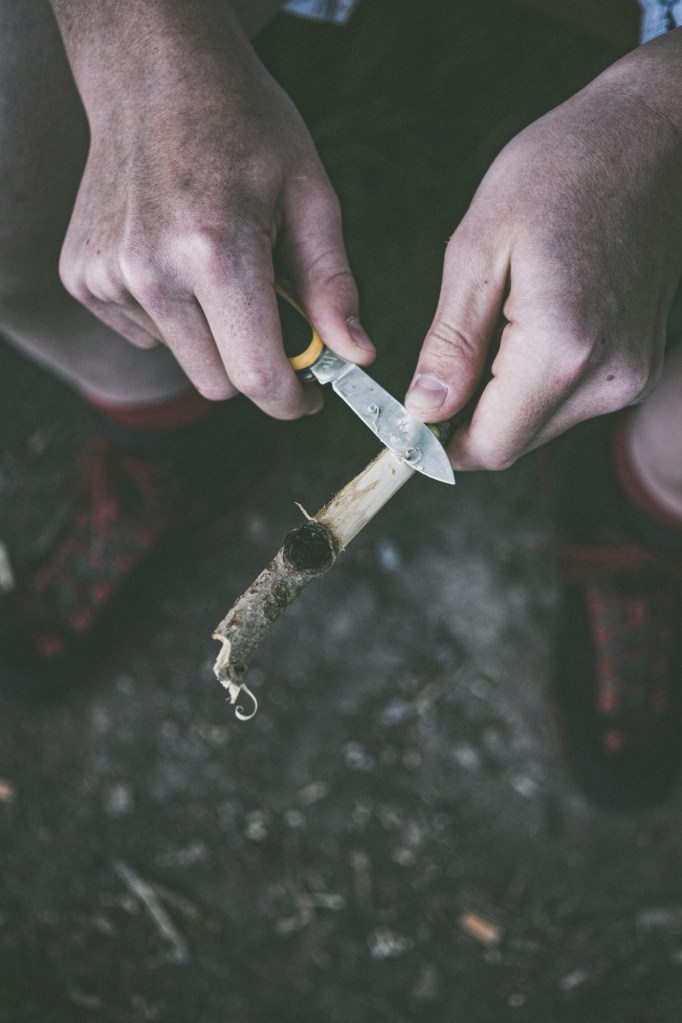
Feather sticks are curls of wood shaved on the end of a stick to help start fires. Making them teaches you fine control and consistency. Try sticks are practice sticks where you carve notches, points, hooks, and other shapes you’ll use in the field.
These teach muscle memory and knife safety. Practice on dry sticks from the yard. Go slow. Focus on technique, not speed.
Tip: Sit on a stump or kneel with a cutting stump in front of you to keep your legs out of the danger zone. Also wear cut resistant gloves for safety.
2. Starting Fires with a Ferro Rod
If you’ve never used a ferrocerium rod before, don’t wait until it’s cold, dark, and windy to try. These rods are reliable but they take practice.
Start at home:
Gather fine tinder (cotton balls with petroleum jelly, dry grass, birch bark, etc.) Hold your rod firm and strike with a solid spine of your knife or a scraper. Aim sparks into the tinder until you get ignition.
Practice until you can do it in just a few strikes. Then try it with natural materials you’ve gathered locally. Once you can light a fire without matches at home, you’ll feel a lot more confident doing it out in the wild.
3. Tarp and Hammock Setup
You don’t need to wait for a camping trip to figure out your gear. Pitch your tarp or hammock in the backyard a few times. Try different knots. Learn what angles keep the rain off, and how tight is too tight.
Practice an A-frame tarp shelter, your hammock hang, or setting up a tent.
The more familiar you are with your setup, the faster you’ll get it up and the safer and more comfortable you’ll be when it counts.
4. Knots and Cordage Work
Every bushcraft shelter, snare, or tool relies on knots. You don’t need a library of them, just a few good ones.
Start with:
Bowline (for secure loops) Taut-line hitch (for adjustable tension) Trucker’s hitch (for tightening lines) Clove hitch (for quick ties)
Cut a few lengths of paracord and practice during downtime. Learn how to tie them with gloves on. Know how to untie them when they’re wet and tight. These little skills add up to real capability.
5. Packing and Layering
This one doesn’t get enough love: knowing how to pack your gear so it’s balanced and accessible and how to dress for changing weather. Try taking a short walk or working outside in your daypack. See what rubs, what shifts, and what you forget.
Why Practice at Home First?
Because the woods are no place for guesswork. When you’re tired, cold, or wet, you want muscle memory, not trial and error.
It’s not “less real” to start in your backyard; it’s smart. Every skill you sharpen at home is one less thing to worry about in the field.
The journey starts where you are. Carving feather sticks on the porch or rigging a tarp between fence posts… you’re building the foundation for a life spent in rhythm with the land.
Start small. Learn well. Be ready for anything.
 The Terra Tactica Outfit